This website uses cookies for a better browsing experience.
Please read and agree to the “Terms of Use”.
If you wish to change your cookie settings, click on “Settings” to customize them.

Our website may store information on your browser or retrieve information from your browser. This information is about you, your preferences, traffic analysis, or your device and is used, in most cases, to make the site function as you expect. To respect your right to privacy, you can choose not to allow cookies. Please note that some cookies are necessary for the proper functioning of the website and their use cannot be stopped on our system.


  • This cookie is necessary for the site to function properly and cannot be stopped in the user's system.
Contact Us
Select Your Country
It all started with a small wooden bearing.
SUSTAINABILITY

Approach to Sustainability & Materiality

With various global initiatives for achieving the Sustainable Development Goals (SDGs) adopted at the United Nations Summit, companies are growing aware that achieving sustainability is an important management priority.
The Oiles Group positively and actively tackles sustainability issues based on the spirit of "serving society through technology," expressed in our corporate philosophy, to achieve development and create new corporate value for the Group.
We position our contribution to solving the sustainability issues exemplified by Environment, Society, and Governance as the mainstay of our corporate activities and promote various initiatives to do so.

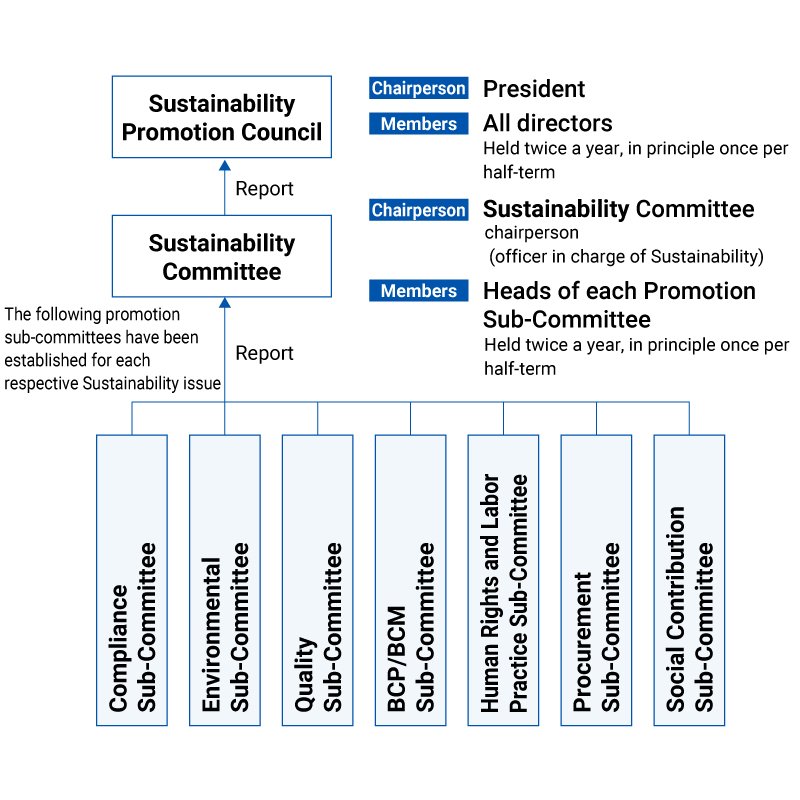
Achieving sustainability depends upon fostering a corporate culture in which each and every employee views sustainability as a key value under the leadership of top management. The Oiles Group holds its Sustainability Promotion Council twice a year, chaired by the President and attended by all directors and operating officers. At this meeting, management deliberates on initiatives and progress regarding sustainability issues such as our environmental response and diversity, as well as matters concerning important sustainability issues. Under the Sustainability Promotion Council, we have established a Sustainability Committee chaired by the director in charge of sustainability. The Sustainability Committee promotes key sustainability issues for the Oiles Group and it discusses matters identified in the PDCA cycle. It reports important matters to the Sustainability Promotion Council.
In addition, six sub-committees organized to promote each sustainability issue operate under the Sustainability Committee, working to resolve each issue.

Major Issues (Materiality) for Sustainable Growth

The Oiles Group recognizes that sustainable corporate growth is important to creating and developing new corporate value. That growth is based on our further development of non-financial capital (human, manufacturing, intellectual, natural, and social and relationship capital). That development has thus been identified as “Materiality for Sustainable Growth.” By enhancing our efforts regarding this materiality, we intend to help resolve social issues, including the SDGs, and pursue the sustainable growth of the Oiles Group and the enhancement of its corporate value.

Reviewing Materiality from the Perspective of Sustainable Growth

Step 1: Identifying the social issues to be addressed
Based on sources that include international standards such as ISO 26000, major guidelines, external ratings, and international integrated reporting frameworks, we identified more than 50 social issues that companies are expected to address to achieve sustainable growth.

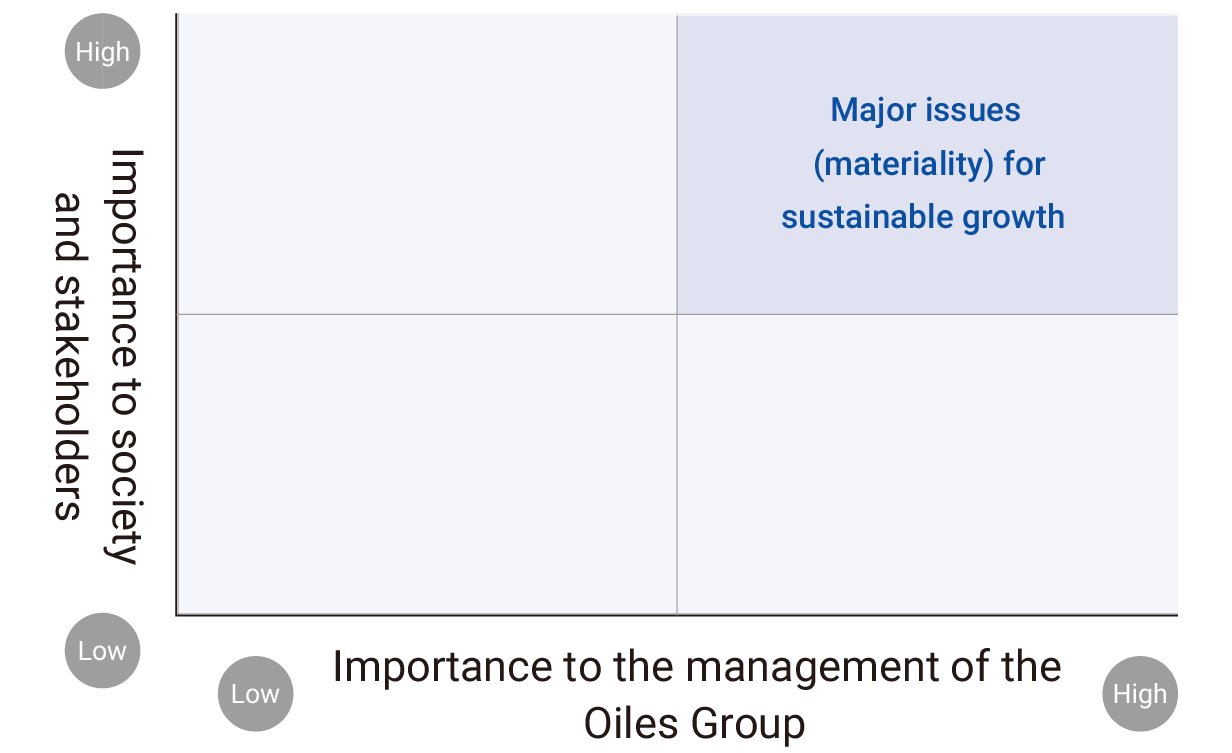
Step 2: Analyzing the importance to society and stakeholders (vertical axis assessment)
We assessed the level of importance of the issues identified above to society and stakeholders (vertical axis assessment) while referring to the assessment parameters of ESG assessment organizations and survey items from customers.

Step 3: Analyzing the level of importance to the management of the Oiles Group (horizontal axis assessment)
We added the issues identified above to the Long-Term Vision and assessed their importance to the management of the Oiles Group from the perspectives of both our new Medium-Term Management Plan and the implementation of each department's plans (horizontal axis assessment).

Step 4: Identification of materiality
Based on the materiality matrix derived from assessments on the vertical and horizontal axes above, the Sustainability Promotion Council, which consists of management, identified materiality for the sustainable growth of the Oiles Group.
Materiality for Sustainable Growth

Materiality Relevant SDGs Opportunity Risk Major initiatives
S: Society
Developing and providing advanced products and technologies that contribute to the resolution of social issues
Developing advanced products and technologies to satisfy and surpass customer needs
  • Strengthening competitiveness and enhancing corporate value as a market-creating company
  • Achieving the sustained enhancement of corporate value by benefiting three parties, i.e., customers, society, and the Group
  • Decreased competitiveness as a company due to a weakened ability to innovate
  • Continue prioritizing the allocation of management resources (R&D expenses, personnel) to research and technology development
  • Significantly expand floorspace for technology and R&D by restructuring the Fujisawa Plant (construct new plant building)
  • Promote the development of products and technology that contribute to solutions to climate change issues in areas such as EVs readiness and renewable energy
Contributing to the evolution of the mobility society
Improving product quality
E: Environment
Environmental initiatives
Preventing global warming
(addressing climate change issues)
  • Increasing corporate value by providing products and technologies that help resolve climate change issues
  • Gaining stakeholder confidence through recognition of the Company’s environmental responsiveness
  • Loss of profit opportunities if the company fails to develop and enhance products that address climate change issues
  • Possibility of losing credibility with customers, shareholders, and others if our CO2 emissions reductions are inadequate
  • Interruption to the Group’s production activities due to unprecedented natural disasters (especially wind and water damage)
  • Promoting initiatives to achieve environmental targets for carbon neutrality by 2050
    - Implementing full-scale solar power generation at the Fujisawa Plant and other initiatives
    - Introducing renewable energy at each manufacturing site
  • Promoting the development of products and technologies involving environmental resources that help to resolve the issue of climate change, such as supporting the transition to EVs and the area of renewable energy
Sustainable use of environmental resources
S: Society
Human resource measures
Human resource development
  • Ensuring corporate growth by attracting talented and diverse personnel who share the Company’s vision
  • Increased corporate value achieved by improving employee engagement
  • Impact on continuity of employment due to the decline in the working-age population and increased competition in recruitment
  • Damage to corporate value due to penalties and criticism of inappropriate labor practices
  • Promoting initiatives to diversify our workforce
    — Improve our ratio of female employees, not only by setting targets for female managers, but also by setting targets for the hiring ratio of female newgraduates
  • Promote KENKO Investment for Health so that our employees can
    work in good physical and mental health
    Foster an environment and culture for employees to grow together with the Company and raise employee engagement
Diversity and inclusion
Respect for human rights and appropriate labor practices
G: Governance
Corporate governance
Enhanced governance
  • Gaining trust from stakeholders by enhancing corporate governance
  • Achieving stable management through appropriate risk management and the establishment of a robust compliance system
  • Damage to corporate value due to inadequate corporate governance
  • Occurrence of scandals due to inadequate compliance

  • Enhancing the effectiveness of the Board of Directors
    — Transition to a company with an Audit and Supervisory Committee
  • — Improve operation of the Board of Directors based on a survey to evaluate the Board’s effectiveness